Cadro Tail Lift Buyer Guide
How to Specify a Tail Lift for Refrigerated Trucks Without Slowing Dock Operations
Dock-ready refrigerated truck liftgate planning
A practical article for refrigerated-truck buyers evaluating dock-ready stowage, stable lifting, platform behavior, low-temperature serviceability, and fleet uptime.
Refrigerated Truck Tail Lift Requirements
First, refrigerated-truck fleets do not choose tail lifts the same way that general cargo fleets do. A reefer truck may need to ground-load on one stop and reverse to a dock on the next stop.
Therefore, loading speed and rear access matter just as much as rated capacity. In daily cold-chain work, those details decide whether a route stays smooth or starts losing time.
In addition, current public sources point in the same direction. Great Dane keeps framing refrigerated equipment around uptime, thermal performance, and operating visibility.
Meanwhile, Maxon keeps highlighting dock-ready stowage and level platform behavior. However, public Alibaba pages still focus heavily on voltage, platform size, and lifting capacity.
As a result, Cadro has a clear content opportunity: explain what a fleet buyer should check before choosing a hydraulic tail lift for a refrigerated truck.
Start with route logic, not just payload
First, the question is not only “How many kilograms can the platform lift?” Instead, the better question is how the truck actually works on its route.
For example, a refrigerated truck that mostly backs to docks has different liftgate needs from a truck serving supermarkets, convenience stores, restaurants, and pharmacy deliveries.
Before comparing models, buyers should map:
- how often the truck must stay dock-ready;
- how often it ground-loads with carts or pallet jacks;
- the heaviest normal payload and how stable that payload is;
- whether multiple temperature-sensitive stops compress unloading time;
- whether rear-door access must stay simple between deliveries.
Therefore, if the route depends on mixed dock and street delivery, a tail lift that stores neatly out of the way becomes more valuable. Otherwise, a strong-looking lift can still create rear-access friction every day.
Why dock-ready stowage matters so much on refrigerated routes
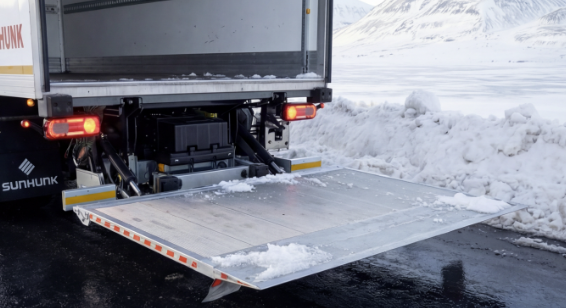
As a result, dock-ready structure matters. For this reason, Maxon product language keeps pushing one practical point: the platform should stow under the body and stay out of the way when dock loading is needed.
In practice, that design logic is often more important for refrigerated fleets than simply chasing a bigger number on the capacity label.
Platform stability and cargo type deserve equal weight
Refrigerated-truck cargo is rarely uniform. For instance, some fleets move palletized frozen food, while others move mixed cartons, beverage loads, top-heavy carts, or temperature-sensitive products.
Because of this, unstable platform behavior can slow unloading and reduce operator confidence. A buyer should therefore look at:
- whether the platform rides level from truck to ground;
- how the lift behaves with top-heavy carts or repeated pallet-jack movement;
- whether the loading surface stays predictable at high delivery frequency;
- whether the structure supports safe movement in wet, cold, or uneven environments.
Stable guided movement is not a marketing extra. Instead, it directly affects unloading rhythm, product handling confidence, and the operator’s willingness to use the equipment correctly stop after stop.
Low-temperature serviceability is part of specification
Reefer fleets cannot afford tail-lift designs that become difficult to inspect or maintain in real operating conditions. Therefore, serviceability should be part of the specification from the beginning.
In particular, hydraulic lifting performance, hose layout clarity, access to service points, and the strength of load-bearing areas all affect uptime.
Before ordering, buyers should confirm:
- the expected low-temperature operating range;
- how easy it is to inspect and service the hydraulic system;
- whether the structure makes routine maintenance straightforward;
- how the design supports repeated use without creating unnecessary downtime.
In practical terms, Cadro should describe maintenance-friendly design through guided movement, reinforced load-bearing points, stable hydraulic lifting, welded structure integrity, precision assembly, and easier service access.
A better RFQ checklist for reefer-fleet buyers
Before sending an RFQ, refrigerated-truck buyers should prepare answers to these questions:
Which body type and rear-door arrangement does the truck use?
How many stops are dock-loading versus ground-loading?
What is the heaviest routine payload and how is it handled?
Which platform size is needed for stable movement?
Where will the expected ambient and operating temperature range sit?
Must the rear remain dock-ready after the lift is stowed?
How important are service access and maintenance speed?
Are there restraint, dock-bumper, or rear-clearance compatibility requirements?
Where Cadro fits
Ultimately, Cadro’s most credible angle is not exaggerated performance language. Instead, it is practical fit.
Specifically, compact folding design, stable hydraulic lifting, guided movement, reinforced load-bearing points, welded structure quality, precision assembly, and maintenance-friendly access all support daily fleet use.
As a result, the product story speaks directly to fleet buyers who care about uptime, dock access, and unloading flow.
Conclusion
In conclusion, the best tail lift for refrigerated trucks is the one that protects dock access, unloading rhythm, and long-term serviceability at the same time.
Therefore, buyers should choose around route logic, dock-ready stowage, low-temperature use, platform stability, and maintenance access. For Cadro, this creates a stronger buyer guide than generic capacity comparison content.
Need a dock-ready refrigerated-truck tail lift plan? Use the checklist above to prepare vehicle, route, payload, and service requirements before asking for a quotation.
Check Sources