
Lightweight Hydraulic Tail Lifts for Electric Fleets: Payload Optimization & Battery Range Preservation in 2026
Indeed, fleet electrification has reached an inflection point in 2026. The global electric last-mile delivery vehicle market, valued at USD 33.69 billion in 2025, is projected to surge to USD 139.41 billion by 2033 at a compound annual growth rate of 19.9% (Grand View Research, 2026). Meanwhile, the light commercial vehicle liftgate market demonstrates parallel momentum, expanding from USD 2.12 billion in 2025 toward USD 3.35 billion by 2031. Consequently, these two trajectories create a critical engineering challenge: every kilogram added by a conventional steel tail lift cannibalizes the limited payload capacity and battery range of an electric delivery vehicle. Specifically, this article examines how lightweight hydraulic tail lift engineering — leveraging aluminum alloys, composite materials, and energy-efficient hydraulic circuitry — enables electric fleet operators to preserve battery range, maximize legal payload, and maintain operational throughput without sacrificing lifting performance or durability.
1. Why Fleet Electrification Demands Smarter Tail Lift Engineering
To begin with, the payload paradox confronting electric commercial vehicle operators is not theoretical — it is measurable and immediate. Electric delivery vans already carry substantial battery mass. Adding a traditional steel tail lift weighing 350–500 kg further reduces available cargo capacity within strict Gross Vehicle Weight Rating (GVWR) limits. Specifically, according to the Society of Motor Manufacturers and Traders, UK registrations of small vans surged 44.5% in 2024, significantly outpacing larger vehicle segments. As a result, these compact electric vans operate on the thinnest weight margins — a direct demonstration that standard steel liftgate installations often become mathematically unfeasible without rendering the vehicle commercially inefficient.
Furthermore, battery range correlates directly with gross vehicle mass. In fact, research substantiates that each additional 100 kg of unladen weight reduces range by approximately 2–3% under urban delivery duty cycles. Consequently, a 400 kg steel tail lift translates to an 8–12% range penalty — equivalent to losing one delivery stop per route in dense urban networks. Therefore, fleet managers who specify lightweight hydraulic tail lifts address this problem at its source: they preserve battery capacity for propulsion rather than wasting it on unnecessary equipment mass.
In addition, the regulatory environment compounds this urgency. For example, the European Automobile Manufacturers' Association reported that new EU van registrations increased 8.3% in 2024, reaching nearly 1.6 million units. Meanwhile, municipalities across Europe and North America continue introducing stricter low-emission zones. In short, lightweight tail lift engineering has graduated from a desirable feature to a fundamental requirement for electric fleet viability.
2. Core Comparison: Steel vs. Aluminum vs. Composite Tail Lifts
First, the material composition of a hydraulic tail lift dictates its weight, corrosion resistance, fatigue life, and total cost of ownership. Consequently, a systematic comparison across the three dominant material families clarifies the trade-offs fleet operators must evaluate.
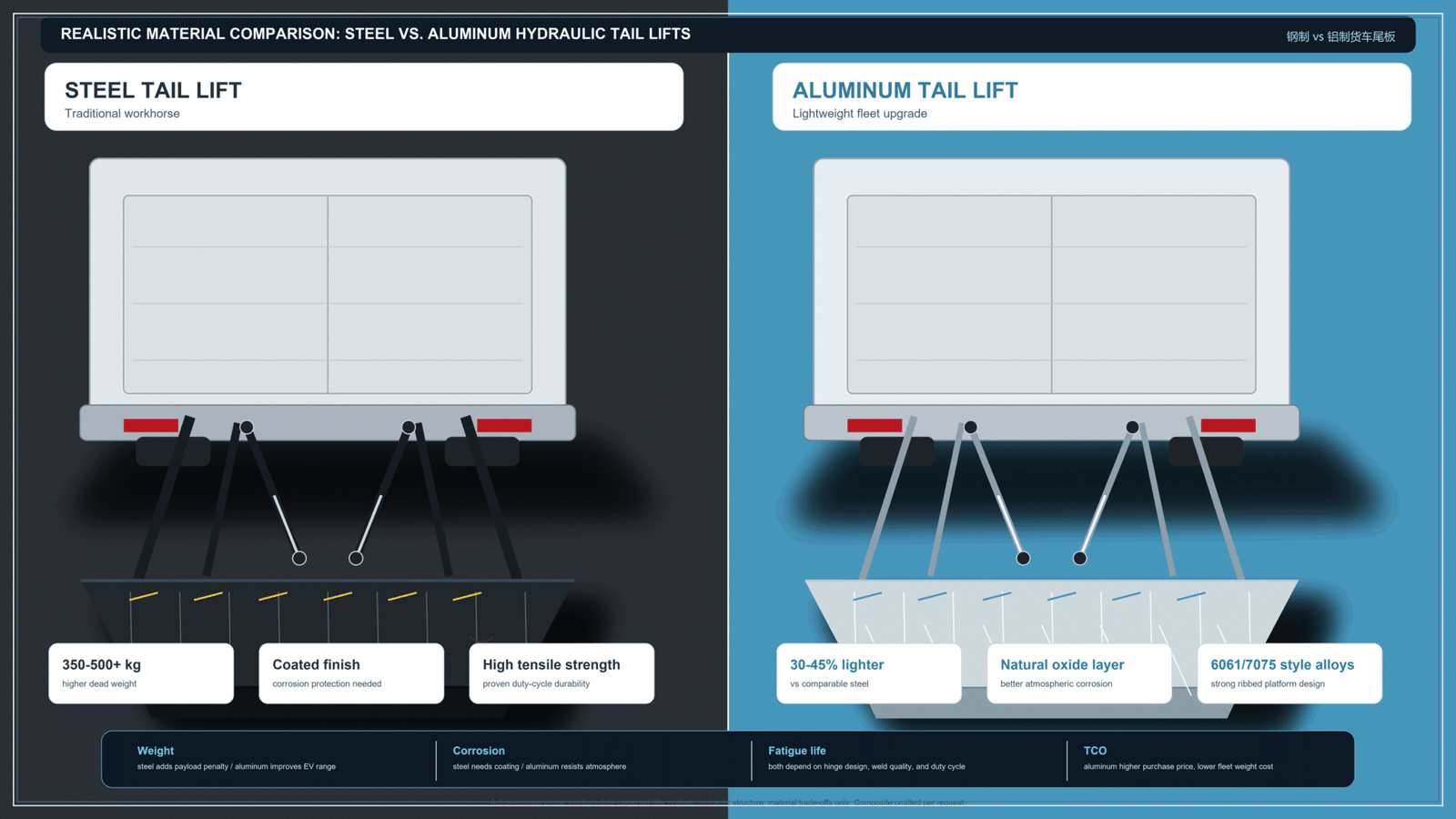
🔩 Steel Tail Lifts — Traditional workhorse. High tensile strength and proven durability. Weight: 350–500+ kg for medium-duty. However, the key disadvantages include an unsustainable weight penalty on EV chassis and the need for ongoing corrosion protection.
🪶 Aluminum Tail Lifts — In contrast, these achieve 30–45% weight reduction vs. steel. Specifically, high-strength 6061-T6/7075-T6 alloys deliver >240 MPa yield strength at one-third the weight. Moreover, they provide natural atmospheric corrosion resistance. Notably, North American aluminum demand rebounded 3.4% in 2024 (The Aluminum Association), driven by transportation lightweighting.
🧬 Composite Tail Lifts — Meanwhile, this fastest-growing segment (TechSci Research, 2026) pushes the envelope further. CFRP/GFRP platforms achieve 50–60% weight reduction vs. steel with superior strength-to-weight ratios. That said, the price premium of 40–70% over aluminum is significant. However, cumulative EV electricity savings frequently justify the difference over 8–12 year lifecycles.
3. Application Scenarios: Where Lightweight Tail Lifts Deliver Maximum ROI
🏙️ Urban Multi-Stop Delivery — First, this represents the highest-value use case. Electric vans performing 40–80 stops/day compound range sensitivity with payload pressure. Specifically, each kilogram saved extends daily range by ~0.3–0.5 km. As a result, an aluminum liftgate saving 150 kg yields ~1,500 additional km/year — equivalent to five full operating days otherwise lost to mid-route charging.
❄️ Cold Chain Logistics — In addition, temperature-controlled EVs face a dual energy burden from propulsion and refrigeration. Consequently, lightweight tail lifts reduce compounded energy draw. In fact, operators report 4–7% reduction in total daily energy consumption with composite platforms under identical route conditions.
🔄 Mixed-Fleet Transition — Finally, lightweight lifts with cross-platform compatibility enable standardized equipment across diesel and electric powertrains. Moreover, this approach simplifies training, spares inventory, and maintenance scheduling during multi-year transition periods.
Planning your fleet's electric transition? Don't let the tail lift become the overlooked variable that undermines your EV investment. Specifically, Cadro's engineering team offers complimentary technical consultation to calculate your specific payload recovery and range preservation potential.
Request Technical Consultation →4. How to Specify a Lightweight Tail Lift for Your Electric Fleet
A structured specification process eliminates guesswork and ensures alignment with both vehicle engineering parameters and fleet operational requirements. Crucially, following four defined phases produces a specification that matches real-world duty cycles.
📋 Phase 1: Establish Vehicle Constraints
First, document your EV's GVWR, unladen weight with battery pack, and remaining payload budget. Next, calculate the weight allowance for auxiliary equipment by subtracting fully laden mass from the legal GVWR. Notably, for most 3.5–7.5 tonne electric LCVs, this allowance falls between 180–320 kg — automatically excluding traditional steel liftgates.
⚙️ Phase 2: Define Duty Cycle Requirements
Subsequently, characterize your operational profile precisely: average lifts/day, maximum single-load weight, cycle time, and environmental exposure. For example, a tail lift rated for 30 cycles/day at 500 kg requires fundamentally different hydraulic circuitry than one designed for 80 cycles at 1,000 kg. Therefore, document the highest-load scenario — not the average — to ensure structural integrity under peak demand.
🔬 Phase 3: Evaluate Material & Hydraulic System Options
Next, compare platforms across unladen mass, rated capacity, and corrosion protection. In particular, aluminum with hard-chrome-plated rods and zinc-nickel treatments provides optimal weight/corrosion/lifecycle balance. Moreover, direct-acting electro-hydraulic systems with regenerative lowering circuits consume 15–25% less battery power per cycle than conventional single-acting configurations.
✅ Phase 4: Validate Through Pilot Deployment
Finally, install on 2–3 representative vehicles and monitor KPIs over a 90-day pilot. Specifically, track daily energy consumption, payload utilization, cycle times, operator feedback, and unscheduled maintenance. Then compare against steel tail lift baselines. As a result, pilot data substantiates the procurement business case with fleet-specific evidence.
5. Cadro Engineering: Precision Manufacturing for the Electrified Fleet Era
Cadro (凯卓立) approaches hydraulic tail lift manufacturing with an engineering philosophy prioritizing three outcomes: structural reliability under asymmetric loading, corrosion resistance across diverse environments, and weight efficiency that preserves vehicle payload and energy budget. Below, we examine how this philosophy translates into concrete manufacturing specifications.
Hydraulic Cylinder Excellence: For instance, multi-stage hard chrome plating achieves surface hardness exceeding 900 HV (Vickers), providing exceptional resistance to pitting and abrasive wear. Additionally, polyurethane/PTFE composite seal systems maintain hydraulic integrity from -30°C to +80°C. Consequently, this engineering discipline directly correlates with extended MTBF and reduced unscheduled maintenance.
Structural Fabrication Rigor: Specifically, automated CNC cutting and robotic welding maintain dimensional tolerances within ±1.5 mm. Meanwhile, post-weld stress relief mitigates residual stress concentrations. Furthermore, cathodic electrodeposition (E-coat) priming plus UV-resistant polyurethane topcoats deliver salt-spray resistance exceeding 1,000 hours (ASTM B117). In short, these processes directly translate to extended service life in coastal, high-humidity, and winter road-salt environments.
6. Real-World Outcomes: What Fleet Operators Report
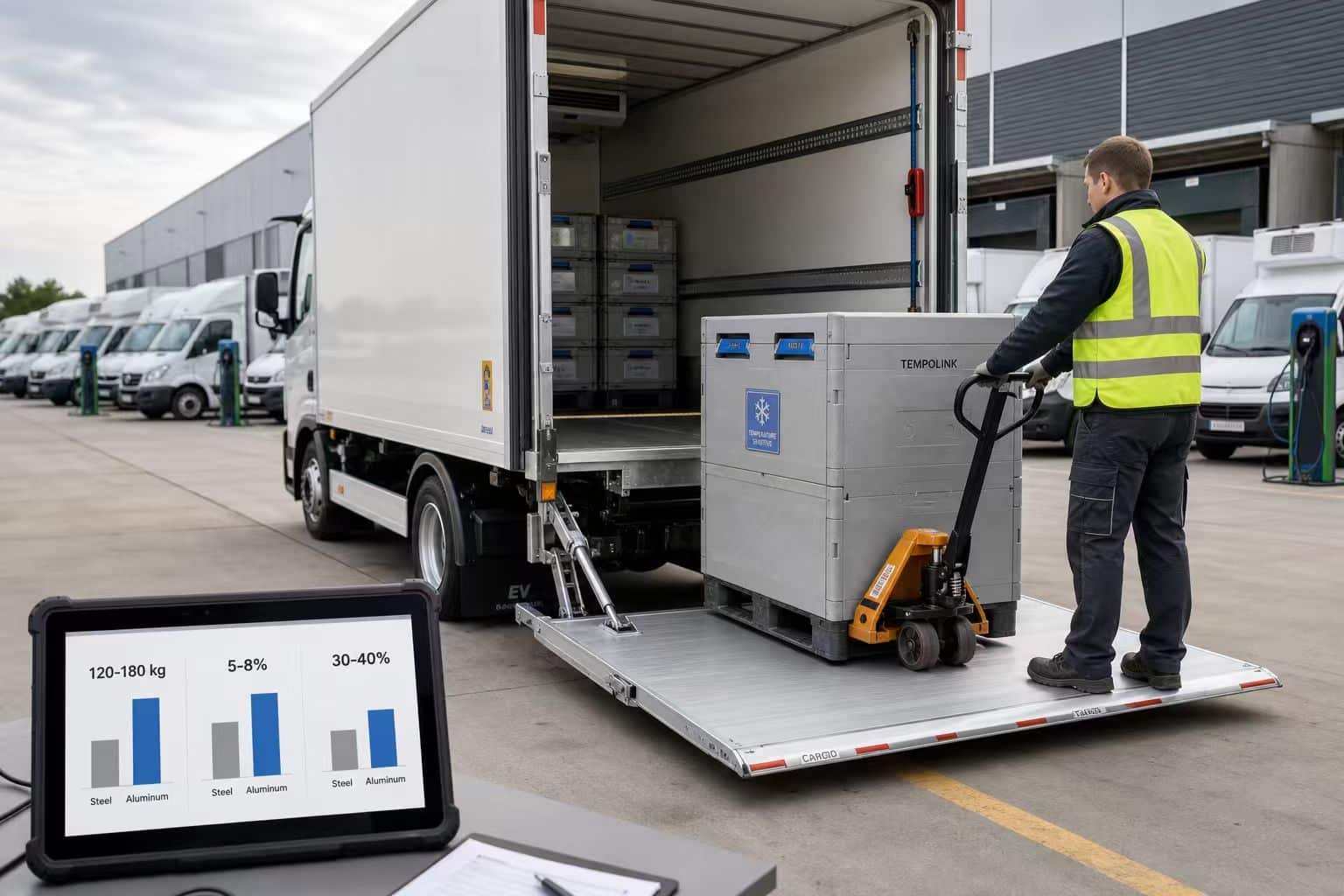
Notably, operational data from fleet deployments validates the advantages of lightweight hydraulic tail lifts. For example, logistics operators transitioning from steel to aluminum platforms on electric delivery vans reported an average payload recovery of 120–180 kg per vehicle, directly increasing daily delivery density. Additionally, cold chain operators documented a 5–8% reduction in total daily energy consumption.
Furthermore, telematics integration has transformed maintenance. Specifically, the 2025 Fleet Technology Trends Report (Verizon Connect) showed 78% of fleets utilized telematics in 2024, a five-point year-over-year increase. As a result, IoT-enabled tail lifts with embedded cycle counters enable predictive maintenance scheduling that reduces unplanned downtime by 30–40%.
Moreover, the human factor substantiates the case further. For instance, the UK Health and Safety Executive classified transportation and storage among the top three most dangerous industries. Consequently, hydraulic tail lifts directly eliminate the manual lifting of heavy cargo — the activity most strongly correlated with musculoskeletal injuries in logistics operations.
7. Frequently Asked Questions
Q: How much weight can an aluminum tail lift save compared to steel?
For a standard 3.5-tonne electric van, aluminum construction reduces unladen mass by 120–180 kg vs. equivalent steel. In addition, for medium-duty 7.5-tonne applications, savings of 200–350 kg are achievable. Consequently, this reclaimed mass converts directly to additional payload or extended battery range.
Q: Do lightweight tail lifts compromise lifting capacity or durability?
No. In fact, modern aluminum alloys (6061-T6, 7075-T6) and composite materials deliver load-bearing capacity equivalent to traditional steel designs. Moreover, yield strengths exceed 240 MPa, and reinforced stress points ensure durability under high-duty-cycle operation.
Q: Are lightweight tail lifts compatible with all electric vehicle models?
In most cases, manufacturers offer mounting kits for common electric commercial vehicle platforms. However, fleet managers should confirm compatibility with their specific model, GVWR class, and chassis configuration during the specification phase. Nevertheless, custom solutions remain available for non-standard applications.
Q: What is the cost premium for a composite tail lift versus aluminum?
Admittedly, composite platforms cost 40–70% more than aluminum due to higher material and manufacturing costs. However, when amortized over an 8–12 year lifecycle and combined with EV electricity savings from reduced mass, total cost of ownership frequently favors composite for high-utilization urban fleets.
Q: How does a lightweight tail lift affect maintenance requirements?
First, aluminum and composite platforms eliminate corrosion-related inspections and recoating. In addition, IoT-enabled diagnostics enable predictive maintenance scheduling, reducing unplanned service events by 30–40%. Furthermore, hydraulic systems with hard-chrome-plated cylinders further reduce lubrication needs.
Q: Can lightweight tail lifts handle asymmetric off-center loading?
Yes. Specifically, properly engineered lightweight platforms incorporate reinforced structural members and balanced hydraulic cylinder configurations that tolerate asymmetric loads within rated capacity limits. However, operators should follow manufacturer guidelines for off-center loads exceeding 75% of rated capacity.
Ready to Optimize Your Electric Fleet's Payload and Range?
As we have demonstrated, the electrification of commercial vehicle fleets represents the most consequential operational transition in modern logistics. However, the tail lift — often treated as a commodity afterthought — directly determines whether that transition succeeds at the route level. In contrast, operators who specify lightweight hydraulic tail lifts engineered for EV compatibility extract maximum value from their electrification investment.
Cadro (凯卓立) manufactures hydraulic tail lift systems combining weight-efficient engineering with the durability and corrosion resistance required for demanding commercial duty cycles. Moreover, our technical team provides data-driven consultation tailored to your fleet profile.
Visit https://cadro-taillift.com/ for detailed engineering documentation, installation guides, and fleet consultation.